
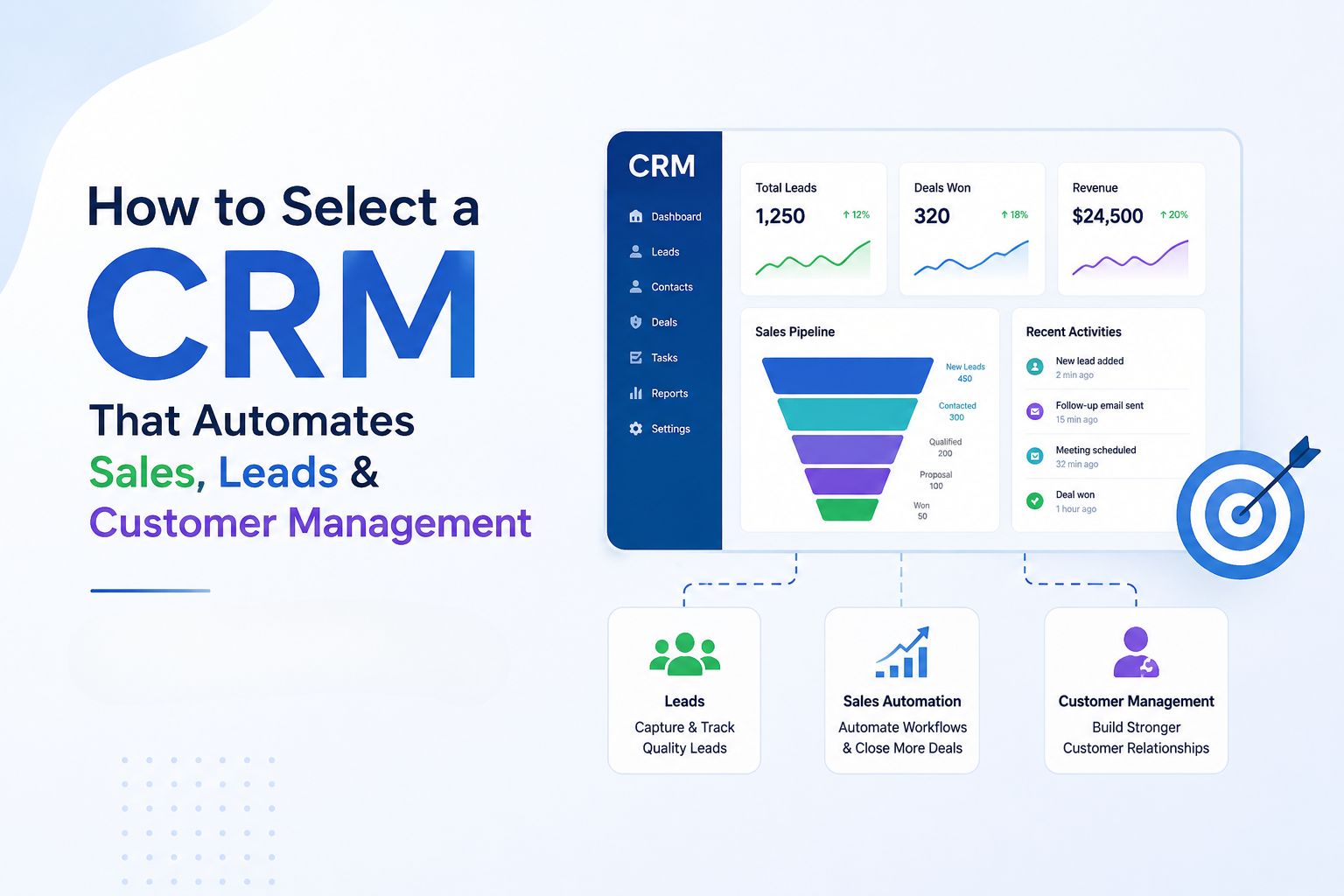
For growing businesses, comes a time when follow-ups are ignored, leads are cold, and despite the impressive appearance of their sales pipeline, it doesn’t work at all. At this stage, a business tends to search for a CRM system. This is usually where people begin when looking for a CRM system. The task is difficult because there are so many options out there, all saying they do automation, sales, and customer management. But the real challenge isn’t finding a CRM solution; it’s finding one that actually saves time instead of just moving it around. This blog covers how to really choose a CRM that automates sales, leads, and customer management.
What Does Real CRM Automation Actually Look Like?
Although most CRMs are automated, automation means that a CRM automates such activities as scheduling follow-ups, distributing leads, managing the pipeline, and reminding about stuck deals. These capabilities can be found in CRMs like HubSpot CRM and Salesforce CRM. However, depending on the configuration, the amount of automation differs. How do you differentiate between the two? If employees have to remember each step individually, then the CRM system is not automated.
Why Choosing the Wrong CRM Costs More Than You Think?
With proper utilization, the CRM system can help boost sales income by 29%, as well as sales efficiency by 34%. Companies utilizing the automation feature of the CRM system will be able to save four to five hours a week. However, choosing the wrong CRM means losses for the company. According to sources, it is said that up to 20%-70% of CRM implementation projects end in failure, simply because the CRM system did not match the business process. Indeed, 37% of companies incur financial losses as a result of poor CRM data quality.
Key Questions to Ask Before Selecting Any CRM
The majority of poor CRM decision-making occurs before the software has even been chosen. Instead, start by asking yourself:
Firstly, ask yourself:
- What work is taking up your employees’ time?
It’s impossible to do effective automation without knowing what needs to be automated. You may need to automate follow-ups, data input, or even lead allocation. - Where is your sales process falling apart?
Every business has a point at which its sales process breaks down. Your CRM should address that issue. - Where are your leads coming from?
If leads are generated through advertising, online forms, calling, and live chats, the CRM system needs to integrate all leads immediately. - Which apps are you currently using?
Integration of apps such as email, calendars, ads, and scheduling will be crucial in avoiding fragmentation. - Will your team even use it?
Even the most effective CRM will fail if it is not used. - Will you grow rapidly?
A CRM that works perfectly for five users might break down for fifty users.
Revenue Driving CRM Automation Features
When it comes to automation, there’s no comparison with mere surface-level features; some make money, but others only look good during demonstrations.
- Post-Sales Automation
It is usually overlooked. Activities such as onboarding emails, follow-up emails, renewals, and upsells should happen post-sale automatically. - Lead Capturing and Assignment Automation
The bottom line here is speed. The right CRM application must ensure that new leads go directly to the right sales representative - Behavior-Based Lead Scoring
The present CRM systems track behavior, including page visits, interacting via email, or asking for a demo. - Automating Follow-Up
If the prospect doesn’t respond anymore, follow-up should be automated through email or text messaging. - Automated Pipeline Progress
The stages of the pipeline should be automated according to progress made, calls made, proposals issued, and contracts agreed. - Integration of CRM with Advertising Tools
Integration of the CRM system with marketing tools like Google Ads campaigns and Meta Ads will help identify campaigns responsible for sales. - Automatic Reporting Dashboards
The reporting dashboards must update themselves for sales managers to see everything in real-time.
Types of CRM Systems
There are three types of CRMs, which are:
- Operational CRM
Related to sales processes such as lead management, follow-ups, and sales pipeline management. - Analytical CRM
Focused on analysis, forecasting, and insight collection of customers. - Collaborative CRMs
Concentrated on integrating sales, marketing, and customer services through shared information.
A new company needs an operational system first before anything else.
Off-the-Shelf or Custom CRM: Which One Fits Better?
Software platforms such as Pipedrive and Zoho CRM are easy and fast to implement and perform excellently with the traditional sales processes. However, the use of these platforms requires companies to make changes to their process to fit into them. Custom CRMs are made from scratch, making them more flexible.
General principle:
- For a basic process, use an off-the-shelf solution.
- For complicated or large-scale processes, custom LMS-integrated CRM systems are recommended.
What AI in CRM Actually Delivers (and What Doesn’t)?
AI has been heavily used in the field of CRM solutions, but not everything marked “AI-driven” gives any value.
Useful applications of AI:
- Lead scoring predictions
- Revenue prediction
- Sentiment analysis in messages
- Automation of data augmentation
Noise in general:
- General insights repeating dashboard insights
- Ineffective chatbots
- Content creation needs considerable editing
Quality AI minimizes decisions. Poor AI just rebrands reporting.
Why Platforms Like GoHighLevel Are Getting Attention?
HighLevel has gained popularity among agencies and smaller businesses because it integrates CRM, funnels, automation, and messaging. Rather than having to switch between different applications, all of this functionality can be managed through one platform, making HighLevel highly beneficial for those overseeing several campaigns or multiple clients.
What a Real CRM Should Do for You?
In a well-designed CRM system, there is much more than contact storage. The CRM system moves deals along, removes duplication, and interacts with clients after completing the deal. In a properly functioning CRM, your sales team will waste less time entering information into their databases and more time selling. That’s how you know if it’s working. Otherwise, you don’t have a CRM; you have an enhanced database.