
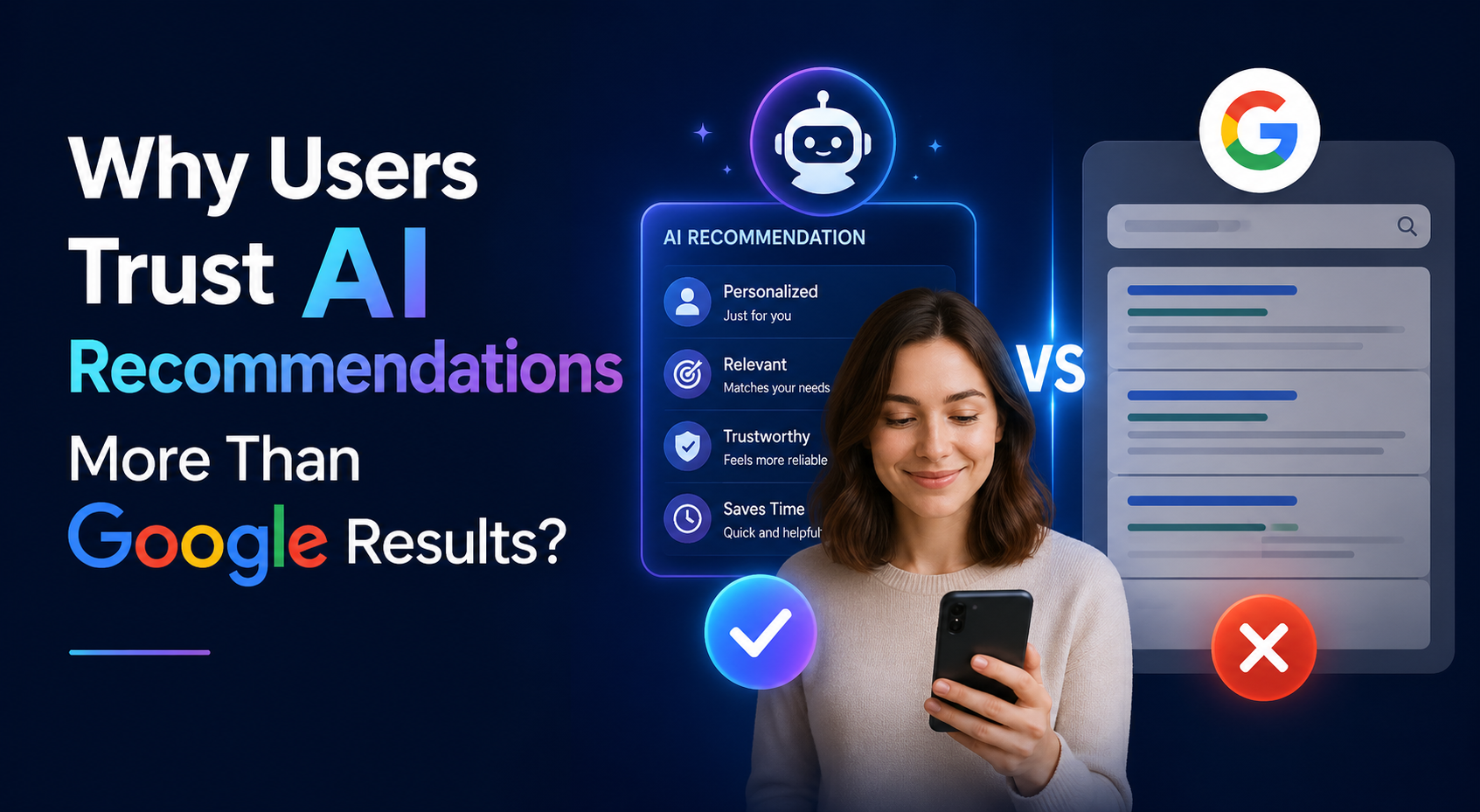
AI Search vs Google: A Fundamental Shift in User Behavior
For many businesses, AI is fast becoming the default search, but many companies are lagging. Google has long set the standard for how users search for and compare information, but this behaviour is evolving rapidly. Consumers do not wish to go through several links or open many pages any longer. Instead, they want easy and concise information, and AI delivers this. It is not just a change in technology but in people as well. People are now concerned about ease, efficiency, and accuracy rather than exploration. They are no longer searching, but making inquiries.
Why Users Trust AI More Than Traditional Search Engines?
The key concern is efficiency because AI saves time while improving accuracy. Another key consideration is cognitive ease. There is no need to go through many sources since there is only one answer to the question. There is a growing sense of neutrality. Individuals know that the search results on their search engines are affected by ads or SEO, while AI results come out naturally. The last reason for using AI is experience, because AI programs have a simple interface without advertisements or distracting information.
The Role of Search Fatigue in AI Adoption
There is search fatigue, and it’s only increasing. Search engine results pages have become littered with advertisements, affiliate links, and content that is more focused on search engine optimization than quality. Issues that people commonly face are as follows:
- Clicking through various links to get one single answer
- Browsing through websites that are full of ads and promotions
- Reading repetitive SEO articles.
This is where the convenience of AI comes into play: Instead of forcing the user to look for something on their own, AI offers fast and relevant results.
The Move from Search Engines to AI Assistants
Individuals have started seeking AI-powered assistance rather than searching through different Google links for immediate and contextual answers. According to Digital Minds Pakistan, this development is influencing users’ behaviors. Consumers today are more interested in immediate clarification than in engaging in extensive searches. This has forced marketers to reassess their strategies for SEO and content creation. Companies should not only aim to appear in search engine rankings but also in AI-produced answers.
Key Statistics Behind AI Search Growth
The emergence of AI-based search is not simply anecdotal; it’s supported by behavioral insights:
- More than 37% of people now start their search process using AI technology
- Approximately 60% feel that AI gives them more accurate responses compared to search engines
- As much as 47% of customers use AI technology in making their purchasing decisions
- More and more people trust AI suggestions over paid advertisements
This shows that a trend is developing; the use of AI is becoming the norm.
AI Search Adoption in the US Market
The United States of America is pioneering the move towards AI-enabled search, setting the pace for future developments globally. Users across the world are increasingly adopting AI technology to conduct their searches, enabling them to make better-informed decisions without wasting much time looking at different websites. It is important to note that the behavior pattern among users in the United States usually spreads globally over time, as seen in areas such as South Asia and the Middle East.
How AI Chooses What to Recommend? (GEO Strategy Explained)
AI doesn’t rank, it selects and highlights. Generative Engine Optimization (GEO) is concerned with citations drawn from AI-based content, not search rankings. AI focuses on:
- Concise and easy-to-summarize structure
- Optimal website performance in terms of technology
- Continuous mentions of your brand from other websites
- Confirmation from sources such as reviews and other external confirmations
This is where AI-driven SEO services come into play to make sure your brand stands out in the generated AI response.
The Hybrid Search Journey: AI + Google
Search is a blend of AI and Google, where each has its own function:
- AI helps in quick comprehension and exploration,
- While Google helps in verification and comparison.
User discovery is done through AI, while verification is performed by searching.
Integration of SEO with AI visibility and AI automation services will help detect all kinds of users. Several companies, such as Digital Minds Pakistan, have started working on making brands fit into this model, so that they get displayed not only through searches, but directly from AI suggestions.
What Does this Mean for E-Commerce Businesses?
How AI is transforming consumer behavior:
- Consumers use AI to find products and make comparisons
- First impressions are made through AI-based summaries
- Purchase decisions are already being affected even before landing on your site
To succeed in the new AI-dominated marketplace, you need:
- Persuasive and benefits-oriented product descriptions
- Specifications that enable proper comparisons
- Reviews and testimonials
- Information answering the buyers’ actual questions
AI will soon become the entry point into e-commerce discovery.
How to Optimize for AI Search and SEO? (GEO Framework)
- Ensure Your Content Is AI-Friendly
Format is key for the AI tool to be able to understand and synthesize your content. Make sure that you are consistent in your use of headings, language, and organization of your information. - Establish Credibility Outside Your Website
Third-party verification is crucial in the functioning of the AI algorithm. The higher the number of references to your company, the higher its reputation and authority. - Improve Your Technical Efficiency
Technical factors of your website contribute greatly to the success of your SEO and AI efforts. Make sure that your website is optimized for efficiency and speed. - Implement a Marketing Strategy
A good marketing strategy is extremely important. The effective combination of SEO, AI, and ROI-driven PPC management will help you capitalize on both short-term and long-term benefits.
What Does this Mean for Your Business?
Without AI optimization for your brand, you are missing out on high-intent visibility.
These are the things that most brands lack:
- Fewer backlinks mean lower levels of trust for AI algorithms
- Unstructured information makes citation impossible
- Poor site speed affects search engine rankings and visibility
For companies to succeed in the current online world, digital marketing must go beyond SEO.
Common Questions About AI Search
- Is AI taking over Google search?
No. AI is changing the way we search, not replacing search engines. They now go well together, forming a hybrid system. - Why do users find AI recommendations appealing?
The reason is that AI gives them simple answers, which are not difficult to comprehend and have no distractions.
The Future of AI-Driven Search Behavior
The application of AI to search technology is not merely a fleeting trend but rather a permanent shift in search technology. As technology advances in AI, the need for AI in decision-making will continuously grow. Early adopters will have an upper hand, while non-adopters will lose their visibility even before appearing in search results.
Adapt or Fall Behind
It’s easy for customers to rely on the AI-based recommendation since it meets all their modern demands fast, efficiently, and clearly. What does this mean for business? Appearing only in Google searches is not enough anymore; you have to make sure that your brand is also seen by AI-based platforms. The change has started happening. The only question is whether your approach is evolving or lagging.